Aubrey Cortez grew up in a home dedicated to service. When Hurricane Harvey flooded her Houston neighborhood, Aubrey’s mother raised money, organized the cleanup, and rallied the whole family to help rebuild homes. “I was homeschooled and always doing service projects with my mom,” Aubrey said. “It sparked an early love for helping my community.”
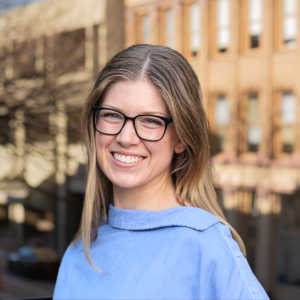 She carried that commitment with her to the University of Dallas, where she helped resettle Afghan refugee families, volunteered at a Dallas food bank, and even started her own organization offering tutoring programs to refugees.
During her final two years of college, Aubrey interned at the U.S. Department of State and accepted a full-time role there after graduation, working on refugee policy. “After working at the local level, I wanted to learn how to more efficiently impact policy at the federal level,” she said.
Today, Aubrey serves as an Education Policy Analyst at Watershed Advisors, where she helps bridge the gap between federal funding and local implementation. “I spend a lot of my time coordinating between the differing perspectives of higher education and the workforce,” Aubrey said. “It’s an excellent tutorial in how to build consensus and find compromise.” She is also pursuing a master’s degree in public policy at Georgetown University.
For Aubrey, the Bryce Harlow Foundation’s emphasis on integrity is what first drew her to the Fellowship. “Holding integrity at the center of advocacy is completely consistent with my personal priorities when engaging people around policy,” she said. As a Bryce Harlow Fellow, Aubrey looks forward to learning from her mentors and fellow members of the cohort while continuing to develop the skills that have guided her from community service in Houston to a career shaping public policy.

 She attended Drake University in Des Moines to be close to the Iowa caucuses. Cecilia studied politics and economics and worked during two presidential election cycles. She first volunteered on Hillary Clinton’s 2016 campaign and later served as a campus organizer for Elizabeth Warren in 2020.
 An internship with her hometown congressman, Dutch Ruppersberger, introduced Grace to Capitol Hill. “I fell in love with it the second I got there,” Grace said. She continued building her career on the Hill and today serves as a legislative assistant for Congressman Johnny Olszewski, handling his much of his domestic policy and supporting his work on the U.S. House Committee on Small Business.
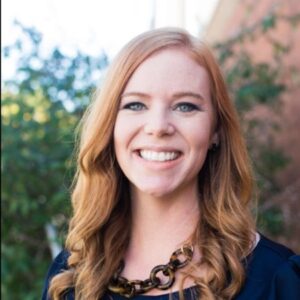 Eventually, when the READ Act was ready to be implemented, Anna moved to USAID and worked for nine years to make the Act operational, helping launch the first U.S. Government Strategy on International Basic Education. At its height, this work reached over 40 million children each year in 55 countries.
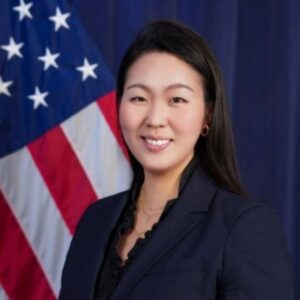 With renewed focus, Naomi returned to her studies at UCLA, where she pursued anthropology along with public policy and political science. During her final semester, she joined Senator Dianne Feinstein’s Los Angeles office and continued there after graduating. In this role, she worked closely with community leaders and local officials, gaining firsthand insight into how federal offices collaborate with state and local partners and how policy is translated into practice.
 Today, Anne is President and CEO of the American Exploration & Production Council (AXPC), representing independent oil and natural gas producers across the country. Since stepping into the role in 2019, she has grown the organization significantly and strengthened its presence across both Capitol Hill and the Executive Branch.
 After law school, James began his career in corporate law in New York but quickly realized he wanted to work closer to policy. “With the help of connections and friendship I made during his time as a Fellow, I was able to make introductions that eventually helped me shift my direction” James said. “Returning to the Foundation allows me to help rising advocates in their careers the same way others helped me.”
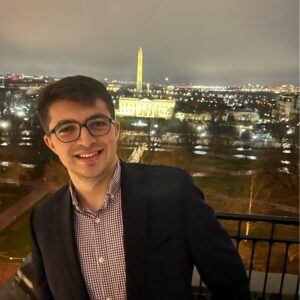 Owen’s interest in politics began at a young age. By twelve, he was volunteering on campaigns and was drawn to the power of ideas and leadership to mobilize people and shape communities. He went on to study politics, philosophy, and economics at the University of Pennsylvania, where he became deeply involved in student political life and clubs including the Penn Wharton Public Policy Initiative.