News and Updates

Get News Updates

Join the Discussion

Sign up to join the Bryce Harlow Foundation listserv email discussions.

Bryce Harlow on Twitter

The Bryce Harlow Fellowship

Today’s post comes from Bryce Harlow alumni fellow, Sarah McDonald.

When I first applied for the Bryce Harlow Fellowship, I knew that I had a passion for Sarah Sobekipublic affairs and the desire to make a difference in the advocacy world, but had not considered lobbying itself as a profession, having always worked on and enjoyed the administrative and grassroots side of advocacy.  However, through the networking opportunities I engaged in as a fellow, including “People You Should Know” luncheons, the interaction with the board of the foundation, and the peer to peer relationships with the other fellows, I began not only to learn more about lobbying, but also to realize that my strengths and education would be well-suited for a career in this other, very interconnected but different, aspect of advocacy.

I was incredibly fortunate to be offered the Bryce Harlow Fellowship for two years, and felt comfortable setting up one-on-one meetings with my mentors and candidly expressing my plan for career growth in the influence industry.  I also found that the content, organization, and scheduling of Bryce Harlow events made attendance not only possible, but a very beneficial use of the limited extra time available to working professionals who are also studying for their Masters’ degrees.

The Bryce Harlow Fellowship is invaluable to any student and professional studying and working in the advocacy field, and I am proud and grateful that I can say the fellowship has directly helped me in my career.  In January of this year, I was promoted to Manager, Government Relations to be a federal lobbyist.  While I know I earned this promotion through hard work and dedication, one of the first emails I sent after learning of the promotion was to thank Linda Dooley, president of the Bryce Harlow Foundation, for allowing me to be a fellow and giving me the ability to take on my new role with confidence.




President Obama’s Lobbyist Problem

Today’s post comes from James A. Thurber, whose latest publication Rivals for Power examines the ongoing power struggle between the president and Congress.

James Thurber

President Obama has fought the influence of lobbyists since the inception of his political career, beginning as the ethics and lobbying reform leader in the Senate in 2006-07 and continuing through his candidacy and eventual presidency. The combination of rising campaign spending and lobbying expenditures, public malevolence toward lobbying, and a general resentment toward Congress have created the perfect political environment for reform.

The president has only fueled these feelings by publicly and repeatedly calling for transparency in the lobbying industry. Chapter 7 from my most recent publication, Rivals for Power: Presidential-Congressional Relations, analyzes whether the president has been successful in his attempts to change the way both Congress and Washington work.

The president has found it difficult however to tame lobbying because of its
size, adaptability, and integral part it plays in America’s pluralist democracy.
Although the number of registered lobbyists has decreased since January 2009, it is
estimated the number of people in DC who are either lobbyists or associated with
the advocacy industry is more than 100,000. And although President Obama has
decried lobbyists for hindering or stopping his policy agenda, undermining
democracy and the public interest, he has publicly praised his stakeholders from
organizations such as the AARP, pharmaceutical industry, and the health insurance
industry in passing his health care reform legislation.

The only difference between lobbyists and these non-registered stakeholders
lies in President Obama’s rhetoric; both cite the first amendment as the cornerstone
of their industry. Throughout my publication, I use examples from President Obama’s
presidency and political career as a whole to draw my final conclusion: that he has
tried to reform lobbying and Congress as a senator, candidate and president, but he
has failed to meet the high expectations of the American public to change the role of
lobbyists and specialized interests in congressional policy making.

Demystifying Lobbying


Juanita Duggan
Today’s post comes from Juanita Duggan, chairman of the Bryce Harlow board.

When I tell  people who live outside of Washington, DC  that I am a lobbyist,  I get a mixture of reactions ranging from deep respect to choleric anger and everything in between.  Regardless of the reaction, I am always struck by how little the public understands about the role of lobbying and the lobbyist in creating public policy.

Most people think that there is something mysterious, magical, and secret about lobbying as if the lobbyist is a form of Harry Potter and the Congress a grown-up Hogwarts. The most misunderstood part of the process is the most basic and least mysterious  — the fact that lawmakers lack information and without lobbyists, lawmakers do not have the information they need to make good public policy decisions.

The public assumes, particularly in the age of the Internet, that a Member of Congress need only push a button and all the relevant information is revealed.  This is a false assumption. The only information lawmakers have is information that is provided by people who will  be affected by a public policy decision. Every public policy decision creates intended and unintended consequences, winners and losers. It is the responsibility of the people whose lives and/or livelihood will be affected to tell the Congress about those consequences, so that public policy is well-informed.

Lobbyists are professional information-gatherers and professional  information-communicators and, without the data they provide, the Congress literally could not conduct the nation’s business. Lobbyists spend most of their time providing data and information to people on Capitol Hill who lack subject-matter expertise and doing it in a way that will cut through the competing “noise” of the other thousands of lobbyists whose issues have equal merit.  It is very hard, important work and there is nothing mysterious about it!

The Right to Lobby – Is More Than a Right


Juanita Duggan
Today’s post is by recently-elected chairman of the Bryce Harlow Foundation board, Juanita Duggan

The First Amendment guarantees the right “to petition the government for redress of grievances,” a right vital to a free society. But I believe that the right to petition — the right to lobby – is more than a right – it is a fundamental responsibility and duty, in particular for the business community. Good public policy cannot exist without vigorous engagement by stakeholders, especially those from corporate America. Yet we can all agree that this right is under attack and is poorly understood by the American public. These attitudes go hand in hand with the public’s growing distrust of its political institutions. So what is to be done to protect the right to petition and to protect the business community’s right to affect public policy? The best way is to ensure that future generations of lobbyists are trained in the values of Bryce Harlow. The BHF takes on this challenge directly by providing scholarships to young professionals who are working full-time in advocacy and going to graduate school at night (as did Bryce Harlow) in order to earn the credentials to be the next generation of leaders who will carry this profession in the future. Along the way we expose them to best-in-class practitioners and teach them the importance of honesty, ethics, and integrity in the profession. BH fellows receive a mentor from our Board who transfers years of experience and practical advice to help them manage their careers. They understand that the best way to be successful in advocacy is to follow the example and values of Bryce Harlow’s storied career.

Former BHF Board member David Rehr, a Professor at the GW Graduate School of Political Management, last year published some ground-breaking research, based on 3,000 surveys, of attitudes of Congressional staffers and lobbyists. The research confirms that the two things that are most valued on Capitol Hill by staff and Members of Congress are 1) the quality and honesty of the information, and 2) the integrity of the person providing it. Honesty and integrity still have more influence than what often passes as “power” in DC. This is very good news, because these are the principles on which the BHF was founded.

I’m a Lobbyist and Proud of It!

Last week the Public Affairs Council sponsored a great workshop called, “I’m a Lobbyist and Proud of It!” Picture a super hero, complete with cape, as the face of a profession that’s all too often misunderstood or simply the scapegoat for all that’s wrong with Washington.  Sounds absurd but just like the life of a super hero, lobbying is hard work built on the knowledge that you subscribe to best practices and your reputation is beyond reproach.

It’s commonly understood that lobbyists are in the information business but it doesn’t stop there. Information must be clearly and concisely communicated and messaged in a way that never compromises the facts.   Lobbyists don’t write the laws, but the lawmakers who do rely on information that demonstrates value to their stakeholders, i.e. their constituents, and it’s important to be clear how the issue being communicated serves the public good.

Other strategies that build success include strategic planning and on the flip side, the ability to be nimble – always prepare alternatives.  The political landscape poses challenges, so understanding it and translating it back to the home office is critical.  Take the long view and don’t get drawn into partisan battles.  Relationships are more important than ever but they have to be meaningful, not just transactional.  And finally, a word about the LDA and HLOGA:  Proud lobbyists know the rules, follow them, and thoughtfully complete the required reports, no matter how burdensome.

One of the speakers said, “The harder you work, the luckier you get.”  Successful lobbyists love what they do because a day in the life of a lobbyist is so unique and challenging.  Without question, the best lobbyists are proud of the organizations they represent and understand that credibility is built over time and can be lost in an instant.  So how do we translate all of this to the rest of the world?  Probably by example, so best to leave your cape at home.

Large Regulation With Extra Unintended Consequences

The next time you order a pizza, try to imagine how many combinations of toppings, crust, and cheese are possible. If you think it’s astronomically high, you’re exactly right – it’s actually over 34 million (according to Domino’s who helpfully did the math). Now consider a provision within the Affordable Care Act that requires chain restaurants to feature detailed breakdowns of ingredients and calories in each possible variation of fresh made foods.

Do individual Papa John’s and Domino’s locations have room for 34 million signs for each pizza combination? If they did, would anyone even see them? The vast majority of their customers get their pizza delivered.

While the intent of these new regulations – aiding consumers in making more healthy dietary choices – is admirable, the unintended consequences are potentially disastrous, particularly if they were extended to related industries like supermarkets and convenience stores as the FDA is now attempting to interpret.

The Food Marketing Institute (FMI), who advocates in Washington on behalf of its 1,500 food retailers and wholesalers, argues strongly that the menu labeling law does not regulate grocery stores and that a law written for chain restaurants shouldn’t be applied to them. FMI estimates that costs associated with supermarkets’ compliance with the new regulations would exceed $1 billion, including nutrition analysis of each item, developing corresponding menu boards and signs, store-level training, and record keeping.

Erik Lieberman, counsel for FMI, explained the potential effect on grocery stores in a recent interview with the Washington Examiner:

“Consider just one fresh-baked blueberry muffin. If one is sold, you need a nutrition sign or sticker. If a half dozen are sold, a different one is required. Same if you sell a dozen.”

Thankfully, professional advocates and a bipartisan group of legislators are bringing some common sense to this process with the introduction of the appropriately named “Common Sense Nutrition Disclosure Act of 2012”. The House bill and its Senate companion would amend the current regulation to allow for sensible solutions like allowing restaurants to provide nutritional information on the Internet – not in 34 million signs.

In the policy making process, good intentions often have unintended consequences and professional advocacy plays a critical role in ensuring common sense in the end.

Lobbying On the Edge

The ‘fiscal cliff’ – automatic tax increases and spending cuts set to take effect on January 1st, 2013, isn’t just dominating the news, it’s top of mind for lobbyists as they work with lawmakers during the lame duck session to help avoid potentially devastating economic effects.

While there is still much disagreement on exactly how to step back from the “edge” of the fiscal cliff, there is near consensus on all sides that it must be avoided.  If not, many economists fear the combination of $500 billion in tax increases and blunt spending cuts could pull the already fragile U.S. economy back into recession.

Nearly every industry and interest group would be affected.  For their part, business leaders continue to urge President Obama and congressional lawmakers to find the quickest possible resolution.  Some, like Morgan Stanley Chief Executive James Gorman, have even taken the unusual step of asking their employees to join in the lobbying effort to avoid the cliff by contacting their members of Congress.

Understanding that business will play a significant role in the negotiations, President Obama is scheduled on Wednesday to speak to the Business Roundtable, an advocacy organization comprised of chief executives of leading U.S. companies.  Business leaders and many Republicans on Capitol Hill have stated their desire to extend the current tax rates for all Americans through 2013, something the administration doesn’t support.

As the January deadline approaches, we are presented with a prime opportunity for quality professional advocates to help bridge the divide between the White House and Capitol Hill and find a solution that eases uncertainty and promotes a stronger, healthier economy.

Cyber Monday Trending on Capitol Hill

Big sales aren’t the only thing attracting lots of attention to the busiest online shopping day of the year. A broad coalition of businesses and lawmakers are working to advance legislation during the lame duck session that would make this the last year Cyber Monday shoppers largely avoid paying sales taxes on their purchases.

The Hill reports:

Under current law, states can only collect sales taxes from retailers that have a physical presence in their state. People who order items online from another state are supposed to declare the purchases on their tax forms, but few do.

The Marketplace Fairness Act (MFA), authored by Sens. Dick Durbin (D-Ill.), Mike Enzi (R-Wyo.) and Lamar Alexander (R-Tenn.), would empower states to collect taxes on online purchases. The bill exempts small businesses that earn less than $500,000 annually in out-of-state sales.

The National Retail Federation, which advocates for millions of retailers of all sizes, has come out in strong support of “sales tax fairness”. From the NRF Retail Means Jobs website:

It’s time to level the playing field so all retailers — no matter which channel they sell in — can remain competitive. While a number of states have passed their own legislation attempting to address the issue, NRF believes the solution to sales tax collection must be mandated by federal law; be fair and apply to all sellers; and be flexible enough for states to adopt and sellers to comply.


Those opposed to the legislation including ecommerce giant eBay Inc. cite concerns that MFA will actually raise taxes and further complicate the tax code and burden on small businesses in particular:

eBay believes that including a robust small business exemption in any Internet sales tax bill is critical to ensuring small businesses play an important role in the Internet marketplace. Therefore, eBay Inc. opposes any attempts by Congress to pass legislation that does not include robust protections for small businesses across the country.

According to research firm comScore, Cyber Monday sales will hit $1.5 billion in 2012 , up 20 percent from 2011, so it’s clear there’s a great deal at stake and advocates from both sides of the issue will working hard to make their case before lawmakers and staff on Capitol Hill. If you’d like to take a break from shopping to show your support for either side of this issue, you’ll find NRF’s grassroots advocacy page here, and the corresponding eBay effort here.

What do you think? Should Congress enact a national Internet sales tax? Tell us why or why not in the comments below.

Giving Thanks For Advocacy

This week as we gather with family and friends to celebrate all we have to be thankful for, take a moment to consider how fortunate we are as a nation to have knowledgeable, experienced professionals working together with elected officials to produce sound public policy. That’s right – be thankful for lobbyists.

No, we’re not kidding.

Yes, advocacy as a trade, and lobbyists in particular, have long played a popular villain in the media and on the campaign trail, and like any industry there are ample bad actors that can be used to support that narrow view. The facts are far less sinister though: professional advocates play a critical role in our government, one that affects nearly every aspect of our daily lives, and even holidays.

However you decide to travel to your destination this Thanksgiving, local and federal lobbyists have played a role. Advocates have fought to modernize your roads and keep the planes you fly in safe.

When you’re at the local supermarket picking up this year’s turkey and other foods that make this holiday so delicious, consider the men and women working for the farmers, the transporters, the grocers, and the consumers to ensure your food is safe, affordable, and plentiful.

Even as you doze off on the couch with one eye on the football game, advocates play a role. They’re working for the NFL, the players, the cable providers, and many others, to produce the product we enjoy every week.

All of this is possible because of the fundamental right as Americans to petition our government. Whether you’re a seasoned professional advocate or a concerned citizen, the First Amendment to the Constitution guarantees your right to be a lobbyist.

That’s something we can all be thankful for.

Tomorrow We’re All Lobbyists

Here at the Bryce Harlow Foundation, much of our time is spent working with lobbyists and future lobbyists to help increase the quality of professional advocacy in the nation’s capital. The business of helping to develop sound public policy can sometimes seem insulated from the rest of the country, and out-of-reach to many Americans.  Tomorrow, and every other November, all of that changes as every citizen has the chance to use the most powerful lobbying tool available: their vote.

Whether you’re passionate about jobs and the economy, education, health care, entitlement reform, or any other issue – tomorrow is your chance to have your voice heard and do your part to shape our government.

To do that, you need to get to the polls.  While the most accurate and up-to-date information on where to vote is kept by your local election official, there are a number of tools available on the Internet to help you find your polling place and even show you what will be on the ballot.

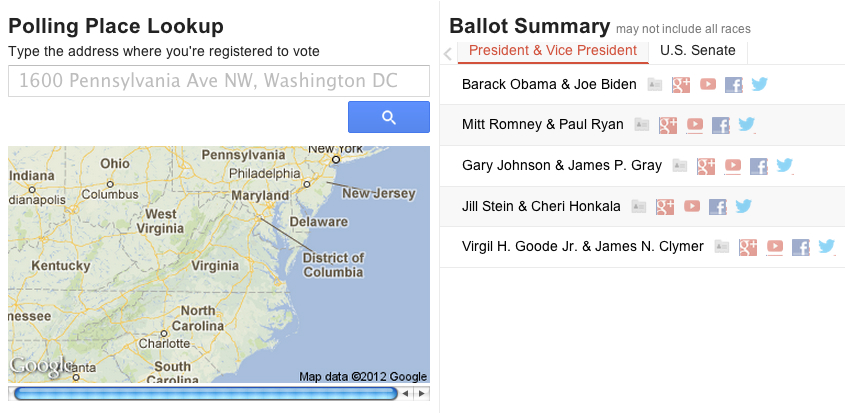
If you click on the image below, you’ll be taken to Google’s Politics and Elections Voter Information page.  There you can enter your address to find your polling location and get more information on the candidates and issues.

find your polling place

Bryce Harlow once summed up his philosophy by saying: “If informed, responsible citizens… will devote an increasing share of their organizational skills and ability to influencing public affairs, then America’s liberty and America’s future will be secure.” Voting is all Americans’ greatest opportunity to do just that –  influence public affairs and secure their future.

Don’t miss your opportunity to lobby for what you care about – get out and vote tomorrow.

Please Share and Follow Us